
Data centers are spreading rapidly across America, aided by local government officials who frequently sign NDAs to hide the development from the people they’re supposed to represent. Often, data center developers target small rural communities, knowing that the public officials don’t have the resources or sophisticated counsel to assist them in pushing back against the data center. One of the key inflection points for any data center is rezoning, when the property is converted to (usually) heavy industrial to allow the development.
While zoning procedures should always include opportunities to voice public opinion, the use of non-disclosure agreements, backdoor deals, and other shady tactics leave communities’ serious fears and concerns unheard or disregarded. People should not feel like they have to fight their own representation to have their voice heard. While many seek legal aid, and I have represented clients across the country on this, one of the most powerful tools at your disposal to fight data centers is the rezoning referendum or initiative.
America’s history has been shaped by the people gathering together to pass referendums and initiatives. Each state has its own unique laws regarding referendums, and many states give voters the ability to submit zoning ordinances to a direct vote of the people. This article outlines the current state of rezoning referendums across the country as of July 2026. This is not legal advice and merely represents a survey of state laws based on the information available at the time of this article.
I am hopeful that this survey will be a valuable starting point for individuals and communities to know whether a referendum may be available to help fight data centers.
As a reminder, if you are seeking assistance with stopping a data center, or seeking to hold a referendum on rezoning, please don’t hesitate to contact the experienced land use litigators at Eckland & Blando LLP.
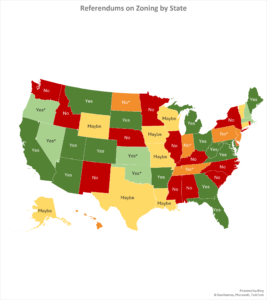
Referendums on Zoning? | |
State | Y/N/M |
| Alabama | No |
| Alaska | Maybe |
| Arizona | Yes |
| Arkansas | Yes |
| California | Yes |
| Colorado | Yes |
| Connecticut | Maybe |
| Delaware | No |
| Florida | Yes |
| Georgia | Yes |
| Hawaii | No* |
| Idaho | No |
| Illinois | No |
| Indiana | No* |
| Iowa | Maybe |
| Kansas | Yes* |
| Kentucky | No |
| Louisiana | Maybe |
| Maine | Yes |
| Maryland | Yes |
| Massachusetts | Yes* |
| Michigan | Yes |
| Minnesota | No |
| Mississippi | No |
| Missouri | Maybe |
| Montana | Yes |
| Nebraska | No |
| Nevada | Yes* |
| New Hampshire | Yes* |
| New Jersey | No* |
| New Mexico | No |
| New York | No |
| North Carolina | No |
| North Dakota | No* |
| Ohio | Yes |
| Oklahoma | Yes* |
| Oregon | Yes* |
| Pennsylvania | No* |
| Rhode Island | No |
| South Carolina | No |
| South Dakota | Yes |
| Tennessee | No* |
| Texas | Maybe |
| Utah | Yes |
| Vermont | Maybe |
| Virginia | Yes |
| Washington | No |
| D.C. | No* |
| West Virginia | Yes |
| Wisconsin | Maybe |
| Wyoming | Maybe |
Alabama: No
Municipalities in Alabama only have powers which are expressly granted by the legislature, or which are implied by those express powers.[2] Alabama has no referendum at the state level, nor has it granted any municipalities with the mechanism to allow referendum.
Alaska: Maybe*
Under state law, municipalities in Alaska are required to provide for referendum and initiative in their charters.[3] The Alaska Supreme Court held that the initiative power does not extend to zoning because it would bypass the planning commission’s role in the process.[4] Referendums on zoning ordinances were not discussed, but this reasoning should not extend to referendums because the zoning ordinance being referred would have already gone through the planning commission’s process. The Alaska Supreme Court has also held that referendums only extend to legislative rather than administrative enactments.[5] Zoning has been considered legislative in multiple cases, but some jurisdictions do consider it to be “administrative.”[6] There is a legal foundation for why rezoning referendums can be held in Alaska, but the Supreme Court has not directly held this and thus it remains unclear at this time.
Arizona: Yes
“A referendum is distinguishable in effect from an initiative in zoning matters. The referendum stays the effect of the action of the law-making body until the electorate has had an opportunity to approve or reject it. It does not change zoning as an initiative would, and the notice and hearing process has been accomplished prior to the referendum.”[7]
The referendum on rezoning was upheld, but initiatives on rezoning are not allowed.[8]
Arkansas: Yes
The Supreme Court of Arkansas held that rezoning can be subject to referendums.[9] However, if a rezoning ordinance is simply authorizing what a previous law provides, it can be considered administrative and not subject to referendum.[10] Thus, this could be a case-by-case analysis on whether a referendum is available.
California: Yes
“…the rezoning of land is a legislative act… subject to referendum.”[11]
Colorado: Yes
“…we find that zoning and rezoning decisions-no matter what the size of the parcel of land involved-are legislative in character and subject to the referendum and initiative provisions of the Colorado Constitution.”[12]
Connecticut: Maybe
Citizens of Connecticut can submit ordinances passed by the legislature of any town, city, borough, or fire district to a public vote.[13] The Supreme Court of Connecticut held that when enacting and amending regulations, local zoning authority acts in a legislative capacity.[14] No case has either directly allowed or foreclosed referendums for rezoning. Notably, the Supreme Court of Connecticut held that in one special act municipality, the charter’s referendum power only reached legislative acts of the council, not to ordinances passed when sitting as a zoning commission.[15] However, this case turned on the individual charter and structure of the municipality, not on the statutory referendum provided in CT ST § 7-157.
Delaware: No
Local governments in Delaware only have powers which are expressly granted to them by the legislature.[16] There is no statewide referendum power, no law vesting local governments with referendum powers, and there is no requirement that Constitutional amendments be submitted for voter approval, signaling a structural reluctance towards direct democracy.[17]
Florida: Yes
Enactment of zoning ordinances and amendments to them are considered legislative and can be subject to referendum.[18] There is no statewide law on this, so the analysis is based on what each municipality provides in their charter.
Georgia: Yes
Counties and cities both have the authority to pass zoning ordinances in Georgia.[19] Counties zone unincorporated areas within their boundaries,[20] and those ordinances are subject to the referendum power provided in Georgia’s Constitution.[21] Cities zone incorporated areas, and these ordinances are also subject to referendum as provided in Georgia law, but at least one Georgia Supreme Court decision has construed the municipal referendum as only reaching charter amendments- not ordinances.[22]
Hawai’i: Probably Not
The state zoning commission zones land in Hawai’i into four districts, and its counties pass specific ordinances in line with those categories.[23] Hawai’i has no statewide initiative or referendum mechanism.[24] The Supreme Court of Hawai’i held that initiatives on county zoning ordinances were not permitted, while mentioning that the question of referendums on zoning ordinances has yet to be resolved.[25]
Idaho: No
Both counties and cities have initiative and referendum powers granted by state law, but these powers are expressly prohibited regarding on zoning ordinances.[26]
Illinois: No
Non-binding referendums on local ordinances and statewide laws are permitted, but binding referendums require a specific statute authorizing them.[27] There is no law authorizing binding referendums on zoning ordinances.
Iowa: Probably Not
Iowa has no statewide referendum right.[28] Iowa cities can adopt a home-rule charter, meaning their powers are not limited only to those expressly granted by the state (and those implicit to those powers). The cities in Iowa that have adopted a home rule charter in theory could allow referendums on zoning, but there is no case that speaks to this. Like in many states, Iowa allows referendums on legislative acts only and considers zoning to be a legislative function.[29]
Kansas: Yes*
Kansas allows referendums only for measures that are “quite clearly and fully legislative and not principally executive or administrative.”[30] To decide whether an act is legislative and thus subject to referendum, courts in Kansas apply the McArdle guidelines. The guidelines are
- An ordinance that makes new law is legislative; while an ordinance that executes an existing law is administrative. Permanency and generality are key features of a legislative ordinance.
- Acts that declare public purpose and provide ways and means to accomplish that purpose generally may be classified as legislative. Acts that deal with a small segment of an overall policy question generally are administrative.
- Decisions which require specialized training and experience in municipal government and intimate knowledge of the fiscal and other affairs of a city in order to make a rational choice may properly be characterized as administrative, even though they may also be said to involve the establishment of policy.[31]
Multiple cases have considered the McArdle guidelines for proposed laws which relate to zoning, but not whether zoning itself is legislative and subject to referendum. Outside of the context of referendum, the Supreme Court of Kansas held that zoning is primarily legislative.[32] Another case says “where the focus of the zoning authority shifts from the entire city or county to one specific tract of land for which a zoning change is urged, the function of the zoning authority becomes more quasi-judicial in nature than legislative.”[33]
There is no direct holding, but case law supports the contention that zoning ordinances should generally be subject to referendum in Kansas.
Kentucky: No
Kentucky law allows for public questions to be submitted to voters if authorized by a statute.[34] No statute authorizes public questions for zoning.
Louisiana: Maybe
Municipalities in Louisiana can adopt home-rule charters.[35] For these municipalities, referendums on zoning are possible but not guaranteed. The Louisiana Supreme Court held, almost a century ago, that municipalities can allow referendums on any proposed ordinance, whether legislative or administrative.[36] In Louisiana, the right to refer zoning laws depends on each municipality’s charter.
Maine: Yes
Maine provides a robust statutory and constitutional basis for voter referendum on zoning ordinances. Towns and plantations have a mandated initiative process.[37] Cities may adopt initiative and referendum for municipal affairs.[38] Zoning referendums have been conducted and adjudicated on the merits in Maine without the referendum right itself being questioned.[39]
Maryland: Yes
“…the Legislature has placed municipal petitions for referendum on zoning matters squarely and exclusively within the purview of the municipal charter.”[40]
Massachusetts: Yes*
For Massachusetts towns, voters directly approve or reject zoning changes as a part of the statutory procedure during town meetings.[41] There is no explicit petition power for towns, but each town’s charter may or may not include one. For cities, there is a referendum mechanism for ordinances.[42] Massachusetts courts have adjudicated zoning referendums on procedural grounds, including challenges to timing and signature requirements, without definitively resolving whether the referendum power extends to zoning ordinances as a matter of law.[43]
Michigan: Yes
“Accordingly, we hold that zoning amendments are legislative acts subject to referendum.” [44]
Minnesota: No
“Minnesota state legislature preempted referendum provisions in cities’ home rule charters when it enacted the Municipal Planning Act and the Metropolitan Land Planning Act.”[45]
Mississippi: No
Absurdly, the Mississippi constitutional article that grants the power to enact constitutional amendments by initiative relies on the state having five congressional districts.[46] When the state’s districts decreased to four, the article became functionally unworkable.[47] It has not been rewritten. The state has no statewide initiative or referendum process.[48] There is also no local process, but the people may amend their municipal charters by petition.[49]
Missouri: Maybe
The right to refer zoning ordinances is a charter-by-charter question. “The Springfield City Charter reserves to the people of Springfield the rights of initiative, referendum, and recall. No language in the charter expressly exempts zoning matters from these rights…”[50]
Montana: Yes
“…the powers of initiative and referendum are reserved to the electors of each local government.”[51] “…zoning is a legislative act that is subject to initiative and referendum.”[52]
Nebraska: No
Excluded from referendum are, “Measures that amend, supplement, change, modify, or repeal a zoning regulation, restriction, or boundary and are subject to protest…”[53]
Nevada: Yes*
Nevada law ensures the powers of initiative and referendum to all cities and counties.[54] These powers are limited to legislation.[55] In Nevada, zoning is generally considered legislative.[56] While determining whether an initiative measure relating to zoning was legislative and therefore subject to initiative and referendum, the Nevada Supreme Court asked whether the measure changes the course of policy for the guidance of the county’s citizens or their officers and agents, in which case it is legislative, or whether it merely executes established policies, in which case it is administrative.[57] It concluded that the initiative was legislative.[58] There is no case that specifically holds that referendums on rezoning are valid, but the legal framework strongly supports that it is.
New Hampshire: Yes*
New Hampshire provides a statewide statutory right to referendum on zoning amendments which allows twenty-five or more voters to petition for a zoning amendment or to repeal a zoning ordinance or code, triggering planning board review and a public hearing before the question is placed on the ballot for a vote by all municipal voters.[59] This right exists independently of the general charter-based referendum framework, which separately excludes land use regulation ordinances from the general ordinance referendum power available to charter cities.[60] The two provisions operate on distinct tracks, 49-C:33(a) forecloses the general charter referendum path for zoning but does not displace the specific statutory petition right in 675:4.
New Jersey: No*
New Jersey explicitly prohibits zoning ordinances, revisions, and amendments that are adopted by initiative or referendum.[61] However, nothing in the statutes “precludes a governing body from measuring the non-binding sentiment of the public,” and there is no prohibition on non-binding referenda regarding zoning decisions in New Jersey.[62]
New Mexico: No
Zoning decisions in New Mexico are governed by the Zoning Enabling Act and are “not subject to referendum.”[63] County zoning ordinances may only be passed “by a majority vote of all members of the board of county commissioners,” thus excluding referenda from being binding decisions.[64]
New York: No
New York zoning enabling acts govern zoning in the state, and do not provide for submission of zoning regulations or amendments to referendum.[65] The Municipal Home Rule Law, which requires and authorizes referenda on certain measures, also does not provide for submission of zoning rules to referendum.[66] “The power to provide for a referendum must be found in the City Home Rule Act. Otherwise it is unauthorized.”[67]
North Carolina: No
North Carolina does not permit state initiatives or referendums, but local-level referendums have been permitted in the state.[68] With that said, as of 2024, down-zoning (such as using zoning to restrict data center use) has been substantially restricted in the state.[69]
North Dakota: No*
There is a statutory mechanism providing for referendums for municipal ordinances in North Dakota, but nothing on its applicability to zoning.[70] While subject to change, a 1981 report by the State of North Dakota AG determined that there is a significant distinction between enacting ordinances and amending zoning locally, and that zoning decisions are not to be made via referendum.[71]
Ohio: Yes
Ohio expressly provides for referendums on municipal ordinances generally, and township zoning amendments are also handled through a specific statutory referendum process.[72] Recent Ohio cases continue to adjudicate zoning-amendment referendum petitions on their statutory sufficiency, confirming that rezoning referendums remain part of Ohio zoning practice.[73]
Oklahoma: Yes*
Oklahoma’s Constitution reserves initiative and referendum powers to local voters, and state law implements those powers for municipal legislation.[74] Because local initiative and referendum are limited to legislative measures, the availability of a zoning referendum should turn on whether the challenged action is legislative rather than administrative. Oklahoma recognizes zoning as an exercise of the police power, but no case located directly resolves whether a rezoning ordinance is subject to referendum.[75] In most jurisdictions, zoning is considered a legislative act.
Oregon: Yes*
Oregon provides local initiative and referendum procedures for city and county measures.[76] Oregon land-use law distinguishes legislative land-use decisions, such as broad comprehensive-plan and development-code amendments, from quasi-judicial or limited land-use decisions.[77] A referendum should be available for legislative zoning ordinances, but individualized land-use decisions are likely governed by the statutory land-use review process rather than referendum.
Pennsylvania: No*
Pennsylvania’s referendum system is statutory and topic-specific, and local referenda generally require express statutory authorization.[78] The Pennsylvania Municipalities Planning Code supplies the procedural framework for zoning enactments and challenges, but no general statute appears to authorize binding referendums on zoning ordinances.[79]
Rhode Island: No
Rhode Island’s Zoning Enabling Act provides detailed procedures for adoption and amendment of zoning ordinances, including council adoption, planning-board review, notice, and hearing requirements.[80] No statewide initiative or referendum mechanism for zoning ordinances was located. Therefore, absent a special charter provision, zoning referendums are probably not available.
South Carolina: No
The Supreme Court of South Carolina has directly held that zoning may not be accomplished through the general initiative and referendum process. The court reasoned that the general initiative and referendum statutes are incompatible with the more specific, detailed statutory zoning procedures.[81]
South Dakota: Yes
South Dakota expressly provides that “the referendum and the right of protest may be invoked against an ordinance making changes in the zoning ordinance in like manner as against the original ordinance.”[82]
Tennessee: No*
Tennessee zoning is governed by specific statutory procedures requiring planning review, notice, public hearing, and governing-body action.[83] Referenda exist in particular land-use contexts such as annexation, but no general statutory or case authority was located allowing binding referendums on zoning ordinances.[84]
Texas: Maybe
Texas does not have a statewide local referendum rule for zoning ordinances. In home-rule cities, the question depends heavily on the city charter and state preemption. Houston is a notable exception because its charter prohibits zoning unless adopted by binding referendum.[85] Thus, referendums on zoning may be available in some Texas municipalities, but not as a uniform statewide right.
Utah: Yes
Utah’s Constitution and statutes reserve initiative and referendum powers to the people, including at the local level.[86] Utah land-use guidance recognizes that legislative land-use decisions, including ordinance and zoning-map amendments, are subject to voter referendum and initiative, while administrative land-use applications are not.[87]
Vermont: Maybe
Vermont allows for permissive referendums regarding municipal ordinances or rules at issue.[88] The issue zoning is not addressed statutorily, but the Supreme Court of Vermont has ruled that rejected amendments may be submitted to the voters; a different procedure, but still a referendum of sorts.[89]
Virginia: Yes
The Supreme Court of Virginia has held that rezoning ordinances qualify as legislative acts and are therefore subject to referendums.[90] Additionally, these referendums can be ordered by the courts of Virginia and will not run into Due Process issues.[91]
Washington: No
Sitting en banc, the Supreme Court of Washington has stated that “zoning ordinances and regulations are beyond the power of initiative or referendum in Washington.”[92] This determination is supported by a line of similar precedent in the state.[93]
Washington D.C.: No*
The main source on this issue comes from a 2025 Attorney General opinion letter. The letter does not address referendums, but determines that initiatives regarding zoning changes violate the Home Rule Act and that zoning map determinations have been congressionally vested in the Zoning Commission alone.[94]
West Virginia: Yes
West Virginia has statutorily authorized and required referendums and procedures regarding zoning amendments in Chapter 8A of the West Virginia Code.[95] Specifically, “[t]he governing body of a county must hold an election on an amendment to a zoning ordinance if a petition, signed by at least 10 percent of the eligible voters in the area to which the zoning ordinance applies, is filed.”[96]
Wisconsin: Maybe
The Wisconsin Supreme Court has taken the issue of referendums in a split over time, determining the application of initiative or referendum on zoning decisions on a more “case-by-case” basis. Direct legislation is subject to four limitations and must: 1) be legislative, 2) not repeal existing ordinances, 3) not exceed the powers conferred to the governing municipality, and 4) may not modify statutory procedures or standards.[97] The application of specific zoning amendments is fact-specific and sometimes turns on the distinction between legislative and administrative actions.[98]
Wyoming: Maybe
Wyoming statutes provide for referendum votes on municipal ordinances and provide a procedure.[99] The Supreme Court of Wyoming has also recognized that zoning decisions are legislative acts, making the argument that they are subject to direct democracy easier, but not conclusive.[100]
[1] Research and drafting assistance provided by D. Kientzle and R. DePaulis, law clerks at Eckland & Blando LLP.
[2] Wilkins v. Dan Haggerty & Associates, Inc., 672 So.2d 507, 509 (Alabama 1995).
[3] AK ST § 29.10.03.
[4] Griswold v. City of Homer, 186 P.3d 558, 563 (Alaska, 2008).
[5] Municipality of Anchorage v. Holleman, 321 P.3d 378, 385 (Alaska 2014).
[6] Cabana v. Kenai Peninsula Borough, 21 P.3d 833, 836 (Alaska 2001); Balough v. Fairbanks North Star Borough, 995 P.2d 245, 267 (Alaska 2000); Griswold v. City of Homer, 925 P.2d 1015, 1019 (Alaska 1996).
[7] Queen Creek Land & Cattle Corp. v. Yavapai Cnty. Bd. of Sup’rs, 501 P.2d 391, 394 (Arizona 1972).
[8] Id.
[9] Summit Mall Company, LLC, v. Lemond, 132 S.W.3d 725, 738 (Ark. 2003).
[10] Id.
[11] Yost v. Thomas, 685 P.2d 1152, 1158 (Cal. 1984).
[12] Margolis v. District Court, In and For Arapahoe Cnty., 638 P.2d 297, 304 (Colo., 1981).
[13] CT ST § 7-157
[14] Parks v. Planning and Zoning Commission of Town of Southington, 425 A.2d 100, 102 (Conn. 1979).
[15] O’Meara v. City of Norwich, 356 A.2d 906, 909 (Conn. 1975).
[16] Green v. Sussex Cnty., 668 A.2d 770, 774 (Del. 1995).
[17] https://ballotpedia.org/Amendments_to_the_Delaware_Constitution.
[18] Fla. Land Co. v. City of Winter Springs, 427 So. 2d 170, 174 (Fla. 1983).
[19] Hall Paving Co. v. Hall Cnty., 226 S.E.2d 728, 729 (Ga. 1976).
[20] Johnston v. Hicks, 170 S.E.2d 410, 413 (Ga. 1969).
[21] Bailey v. McIntosh Cnty., 921 S.E.2d 382, 391 (Ga. 2025).
[22] Kemp v. City of Claxton, 496 S.E.2d 712 (Ga. 1998).
[23] Haw. Rev. Stat. Ann. § 205-2; Haw. Rev. Stat. Ann. § 46-4.
[24] https://ballotpedia.org/Types_of_ballot_measures_in_Hawaii
[25] Kaiser Hawaii Kai Dev. Co. v. City and Cnty. of Honolulu, 777 P.2d 244, 248 (Haw. 1989).
[26] ID ST § 34-1801B (22); ID ST § 34-1801C(21).
[27] IL ST CH 10 § 5/28-1.
[28] https://ballotpedia.org/Iowa_2026_ballot_measures.
[29] Murphy v. Gilman, 204 Iowa 58, 214 N.W. 679, 681 (1927); Worthwhile Wind LLC v. Worth Cnty. Bd. of Supervisors, 34 N.W.3d 782, 790 (Iowa 2026), reh’g denied (May 12, 2026).
[30] McAlister v. City of Fairway, 289 Kan. 391, 212 P.3d 184, 193 (Kan. 2009) (quoting State, ex rel., v. City of Kingman, 123 Kan. 207, 209, 254 P. 397 (Kan. 1927)).
[31] Id.
[32] Paul v. City of Manhattan, 212 Kan. 381, 511 P.2d 244, 251 (Kan. 1973).
[33] McPherson Landfill, Inc. v. Bd. of Cnty. Comm’rs of Shawnee Cnty., 274 Kan. 303, 49 P.3d 522, 524 (2002).
[34] Ky. Rev. Stat. Ann. § 83A.120.
[35] R.S. 33:1395
[36] Dickson v. Hardy, 177 La. 447, 148 So. 674 (La. 1933).
[37] Me. Rev. Stat. Ann. tit. 30-A, § 2522.
[38] Me. Const. art. IV, Pt. 3, § 21.
[39] City of Old Town v. Dimoulas, 803 A.2d 1018 (Me. 2002).
[40] Town of Bel Air v. Bodt, 318 A.3d 570, 584 (Md. 2024).
[41] Mass. Gen. Laws Ann. ch. 40A, § 5.
[42] Mass. Gen. Laws Ann. ch. 43, § 42.
[43] LaBranche v. A.J. Lane & Co., 404 Mass. 725, 537 N.E.2d 119 (1989); Gastown, Inc. v. Bd. of Registrars of Voters of Agawam, 361 Mass. 876, 281 N.E.2d 604 (1972).
[44] Albright v. City of Portage, 470 N.W.2d 657, 661 (Mich. App. 1991).
[45] Nordmarken v. City of Richfield, 641 N.W.2d 343, 350 (Minn. Ct. App. 2002).
[46] Initiative Measure No. 65: Mayor Butler v. Watson, 338 So. 3d 599, 607 (Miss. 2021).
[47] Id. at 608.
[48] https://ballotpedia.org/Laws_governing_the_initiative_process_in_Mississippi.
[49] Miss. Code Ann. § 21-17-11.
[50] State ex rel. Trotter v. Cirtin, 941 S.W.2d 498, 500 (Mo. 1997).
[51] Mont. Code Ann. § 7-5-131.
[52] Egan Slough Community v. Flathead Cnty. Bd. of Cnty. Commissioners, 506 P.3d 996, 1009 (Mont. 2022).
[53] Neb. Rev. Stat. Ann. § 18-2528.
[54] Nev. Rev. Stat. Ann. § 295.200; Nev. Rev. Stat. Ann. § 295.085.
[55] Garvin v. Ninth Jud. Dist. Ct. ex rel. Cnty. of Douglas, 59 P.3d 1180, 1190 (Nev. 2002).
[56] Eagle Thrifty Drugs & Markets, Inc. v. Hunter Lake Parent Teachers Ass’n, 451 P.2d 713, 714 (Nev. 1969); City of Reno v. Citizens for Cold Springs, 236 P.3d 10, 17 (Nev. 2010).
[57] Garvin v. Ninth Jud. Dist. Ct. ex rel. Cnty. of Douglas, 59 P.3d 1180, 1191 (Nev. 2002).
[58] Id.
[59] N.H. Rev. Stat. Ann. § 675:4.
[60] RSA 49-C:33(a),
[61] N.J. Stat. Ann. § 40:55D-62(b); see also Great Atl. & Pac. Tea Co. v. Borough of Point Pleasant, 137 N.J. 136 (N.J., 1994) (applying § 40:55D-62(b)).
[62] Great Atl. & Pac. Tea Co., 137 N.J. at 152.
[63] Westgate Families v. Cnty. Clerk of Inc. Los Angeles Cnty., 100 N.M. 146, 148 (N.M., 1983).
[64] N.M. Stat. Ann. § 3-21-14(C).
[65] Gen. City Law §§ 20(24), (25), 83; Town Law §§ 261 to 285; Village Law §§ 7-700 to 7-742; 12 N.Y. Jur. 2d Buildings § 205.
[66] Mun. Home Rule Law §§ 23 to 25.
[67] Elkind v. New Rochelle, 163 N.Y.S.2d 870, 875 (Sup. Ct. 1957) (internal quotation and citation omitted).
[68] Initiative & Referendum Inst., North Carolina, Univ. of S. Cal. Gould Sch. of L., https://www.initiativeandreferenduminstitute.org/north-carolina.
[69] S.B. 382, 2024 Reg. Sess. (N.C. 2024); N.C. Gen. Stat. § 160D-601(d)(1)-(2).
[70] N.D.C.C. § 40-12-09.
[71] N.D. Att’y Gen. Op. 81-1 (1981).
[72] Ohio Rev. Code Ann. § 731.29; Ohio Rev. Code Ann. § 519.12.
[73] State ex rel. M/I Homes of Cincinnati, L.L.C. v. Clermont Cty. Bd. of Elections, 2025-Ohio-4362.
[74] Okla. Const. art. V, §§ 1, 5; Okla. Stat. tit. 11, § 15-102.
[75] Indian Territory Illuminating Oil Co. v. Larkins, 31 P.2d 608 (Okla. 1934); In re Initiative Petition No. 382, 142 P.3d 400 (Okla. 2006).
[76] Or. Rev. Stat. ch. 250; Oregon Secretary of State, County, City, and District Initiative and Referendum Manual (2024).
[77] Or. Rev. Stat. §§ 197.015, 197.195, 227.175.
[78] Pa. Dep’t of Cmty. & Econ. Dev., Referendum Handbook (11th ed. 2019).
[79] 53 P.S. §§ 10101-11202; 42 Pa. Cons. Stat. § 5571.1.
[80] R.I. Gen. Laws §§ 45-24-50 to 45-24-53.
[81] I’On, L.L.C. v. Town of Mt. Pleasant, 526 S.E.2d 716, 719-21 (S.C. 2000).
[82] S.D. Codified Laws § 11-4-10.
[83] Tenn. Code Ann. §§ 13-7-201 et seq.; Tenn. Code Ann. §§ 13-7-101 et seq.
[84] Tenn. Code Ann. § 6-51-104.
[85] Powell v. City of Houston, 628 S.W.3d 838 (Tex. 2021); Houston, Tex., Charter art. VII-b, § 13.
[86] Utah Const. art. VI, § 1; Utah Code Ann. tit. 20A, ch. 7.
[87] Utah Code Ann. 1953 § 10-20-501; Utah Office of the Property Rights Ombudsman, Voter Initiatives and Referenda.
[88] Vt. Stat. Ann. tit. 24, § 1973.
[89] Smith v. Town of St. Johnsbury, 150 Vt. 351, 352 (Vt. 1998).
[90] R.G. Moore Bldg. Corp. v. Committee for the Repeal of Ordinance R(C)-88-13, 239 Va. 484, 491 (Va. 1990).
[91] Id. at 493.
[92] 1000 Friends of Washington v. McFarland, 159 Wash.2d 165, 174 (Wash. 2006).
[93] Lince v. City of Bremerton, 25 Wash.App. 309, 312–13, 607 P.2d 329 (1980) ((citing Leonard v. City of Bothell, 87 Wash.2d 847, 854, 557 P.2d 1306 (Wash. 1976)); see generally J.R. Kemper, Annotation, Adoption of Zoning Ordinance or Amendment Thereto as Subject of Referendum, 72 A.L.R.3d 1030 (2005).
[94] Letter from D.C. Office of the Attorney General to D.C. Board of Elections (May 7, 2025).
[95] W. Va. Code Ann. § 8A-7-8a.
[96] Id. at (d).
[97] State ex rel. Althouse v. City of Madison, 255 N.W.2d 449, 453 (Wis. 1977).
[98] Compare Mount Horeb Community Alert v. Village Bd. of Mt. Horeb, 263 Wis.2d 544 (Wis. 2003) with Heitman v. City of Mauston Common Council, 226 Wis.2d 542 (Wis. App. 1999).
[99] Wyo. Stat. Ann. § 22-23-1005.
[100] McGann v. City Council of City of Laramie, 581 P.2d 1104 (Wyo. 1978)